To purchase a copy

Title: High Up in the Rolling Hills
Author: Peter Finch


Category: Biography, memoir, manifesto, sustainable living
Format: Trade paperback, hardcover, ebook
Publication Date: April, 2013
Pages: 204
Recommended Price: $17.95 softcover, $27.95 hardcover, $9.95 pdf
Trim: 8.5 x 5.5 inches
Available from: iUniverse; Amazon in Canada, United States, United Kingdom, France, Germany, Spain, Italy, Japan, Brazil; Barnes & Noble; Borders; Chapters Indigo in Canada
First Print Run: On demand (with iUniverse on-demand capabilities, there is never an out-of-stock situation)

Tuesday, 17 March 2026

The Water

“The Water” is a duet beautifully sung by Johnny Flynn and Laura Marling. 

https://youtu.be/a4QQ7HYYdWw


All that I have is a river

The river is always my home

Lord, take me away, for I just cannot stay

Or I'll sink in my skin and my bones


The water sustains me without even trying

The water can't drown me, I'm done

With my dying...


Please help me build a small boat

One that'll ride on the flow

Where the river runs deep and the larger fish creep

I'm glad of what keeps me afloat


The water sustains me without even trying

The water can't drown me, I'm done

With my dying...


Now deeper the water I sail

And faster the current I'm in

That each night brings the stars and the song in my heart

Is a tune for the journeyman's tale


The water sustains me without even trying

The water can't drown me, I'm done

With my dying...


Now the land that I knew is a dream

And the line on the distance grows faint

So wide is my river, the horizon a sliver

The artist has run out of paint


Where the blue of the sea meets the sky

And the big yellow sun leads me home

I'm everywhere now; the way is a vow

To the wind of each breath by and by


The water sustains me without even trying

The water can't drown me, I'm done

With my dying...

**

‘It was about trying to get the male and female voices like river currents, swirling around each other, tracing each other, overlapping.’ (Johnny Flynn)


Tuesday, 20 May 2025

Dali in Cadaques


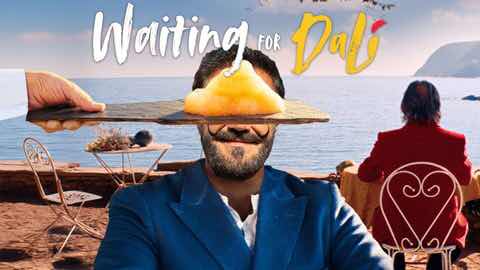
I heartily recommend the offbeat movie Waiting for Dali that we recently watched on the Kanopy 'Thoughtful Entertainment' streaming channel. Set in the lovely fishing village of Cadaques (home of Salvador Dali) on the Costa Brava, it features the escape of two culinary chefs from turbulent political upheaval in 1970s Barcelona.

I was reminded of my account of our own priceless personal experience in Cadaques with Dali and his art in the mid 1980s:

"It was December, 1985 and we were in England ahead of a family Christmas. First we had an exciting side trip to make - cross-Channel ferry to Calais, train to Paris Nord (where we crossed the city to Austerlitz station, loading up in an epicerie on ham, cheese, baguette, and vin rouge), train to Barcelona via the Pyrenees. We missed our connection at the Spanish border and caught up with our train via taxi for the descent into Barcelona. After several days soaking up its sublime cultural, artistic, and physical riches, we rented a car and sped up the Costa Brava coast for a brief but delightful stay in the fishing village of Cadaques, then famous as the home of one Salvador Dali.

My lovely friend Cornelia from Berlin had told me about her trips with amigos to Cadaques which had built a reputation as hangout for bohemians and hippies tripping around Europe in camper vans. We made the descent through the dry olive-groved hillsides to the idyllic bay and precious seafront of the village. It was off-season with a chill and gloom in the air. Our hotel was basic and dining opportunities limited. The food was eminently forgettable, the atmosphere spartan. After dinner we gravitated to the seafront coffee bar and requested a premium brandy. The owner's eyes lit up and he recommended a Carlos Primero or a Cardenal Mendoza. Which did he recommend? Why not both try a glass of each?
As the warm glow of the second glass began to work its magic, the loquacious owner, who joined us in imbibing, launched into stories of his seafaring days and dug out a cassette recording of the melodic sea shanties he and his fellow sailors used to sing to while away the long hours. When a French couple came in and asked for a coffee, he shooed them away saying he was closed, muttering under his breath some profanities about the French. Another brandy (on the house) and a few shared stories later - memory is fuzzy whether it was a Carlos Primero or Cardenal Mendoza - we were ushered by our host into a backroom which served as a gallery for a wall of early abstract Dali pencil drawings. 
"What do you see in this one?" he prompted.
"Circles?" 
"Yes, but you see the horse, no?" 
"Oh, yes, yes"; when I squinted and imagined wildly, indeed I could. 
Here we were, steps away from the legendary artistic and cultural maverick genius himself, yes, still alive yet elusive and enigmatic in the material sense. We got close to seeing him in person, but made do with a rich dose of his ineffable aura. Cadaques at this time, its famous son Salvador Dali still alive, was brimming with art, quirkiness, and his presence. Today, his ubiquitous spirit no doubt remains to regale the charming port, despite its accelerated tourist invasion, with an enduring surreal appeal."


Wednesday, 14 December 2022

The Healing Journey: A Personal Perspective

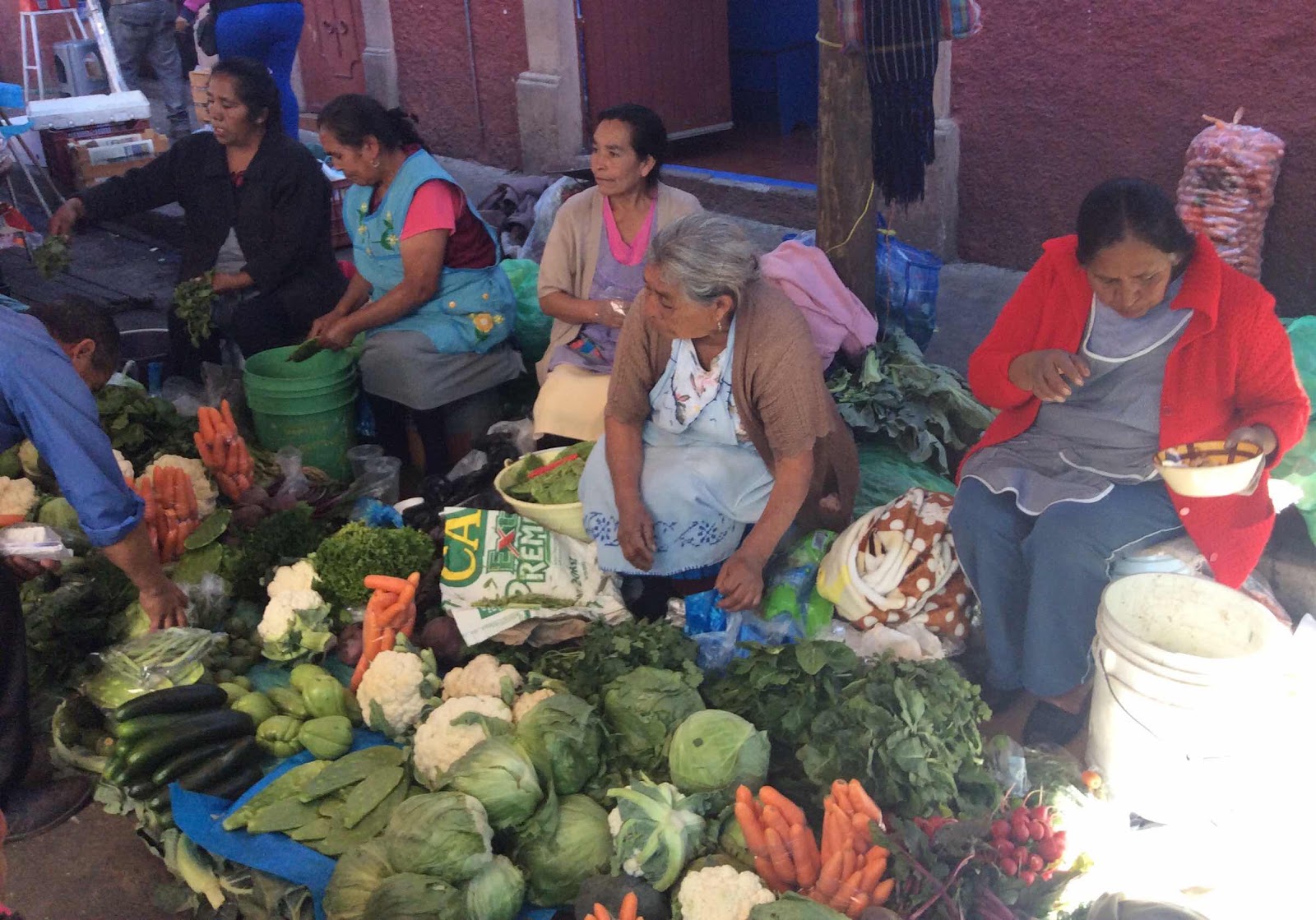
Mexican street market

Sometimes in life a health crisis helps to bring about profound changes in how we approach illness and recovery. Maintaining good health can, after all, be a tortuous journey. 

Health Crisis, Hospitalization
Sixteen years ago my wife became very ill in the last week of a wonderful long winter vacation in Mexico. Having experienced tummy problems from contaminated fruit in Chile a few years previous, we assumed that Gundi had picked up parasites from market food, possibly tainted chicken. On return home, severe diarrhoea continued for a month or so and she lost a ton of weight. Finally we called an ambulance and doctors went busily about administering antibiotics, anti-inflammatories, and IV fluids. Their tests resulting in a diagnosis of the catch-all IBS (Irritable Bowel Syndrome). She was prescribed stronger anti-inflammatories. The visiting surgeon wanted to remove her colon. Worryingly, several weeks in hospital over two stays failed to stem the draining depletion of her system. Have you or yours experienced a health crisis? What mechanisms have you used to see you through?

Fresh lavender bunches

Herbs & Naturopathy
Once the public health system had stabilized her condition somewhat, we turned to a concoction of herbal healing teas from a traditional Chinese medicine (also Western medicine-trained) practitioner. We boiled up the powerful mix of barks, seeds, leaves, flowers, and roots, which smelled awful and tasted barely digestible to Gundi. I told her to get it down her; it is doing you good. With a calm, reassuring and practical manner, the doctor looked his patient in the eyes, examined her tongue, and took her pulse in a variety of ways. He concluded that her system was out of balance and needed adjustment, recalibration. We also returned to a naturopath for homeopathic and energy treatments. My dear big sister in Berlin, also a naturopath, prescribed personalized Bach flower essences formulated from English countryside wildflowers; for Gundi, Rescue Remedy, aspen, olive, Star of Bethlehem, sweet chestnut, wild rose; for me, her carer (yes, carers need care too!), Rescue Remedy, aspen, elm, gentian, hornbeam, pine, Star of Bethlehem. Over a long hot summer during which I pressed on with growing and tending our organic market garden and taking our produce to the city for sale in farmers markets, Gundi began a long recovery and eventually put on the fifty pounds in weight she had lost. We decided to wean her off the strong anti-inflammatories prescribed by her gastro-enterologist to be taken "for the rest of her life". What would you have done?

Pesticides, Food Toxins
When I first came to Canada over forty years ago, I worked first in my cousin's landscaping and lawn maintenance business. I loved it all except the toxic chemical spraying for weeds. In those early days we bought and consumed food that was largely 'conventional', drenched in a chemical cocktail of pesticides, herbicides, fungicides. Organic came later. The fast-consolidating industrial food and farming systems with their processed junk would get their teeth into us first! As Earl L. Butz, as US Department of Agriculture Secretary famously thundered at farmers back in the 1970s: "Get Big Or Get Out". I decided to stay small and carve out a niche, a plan that continues to this day with this latest endeavour! 

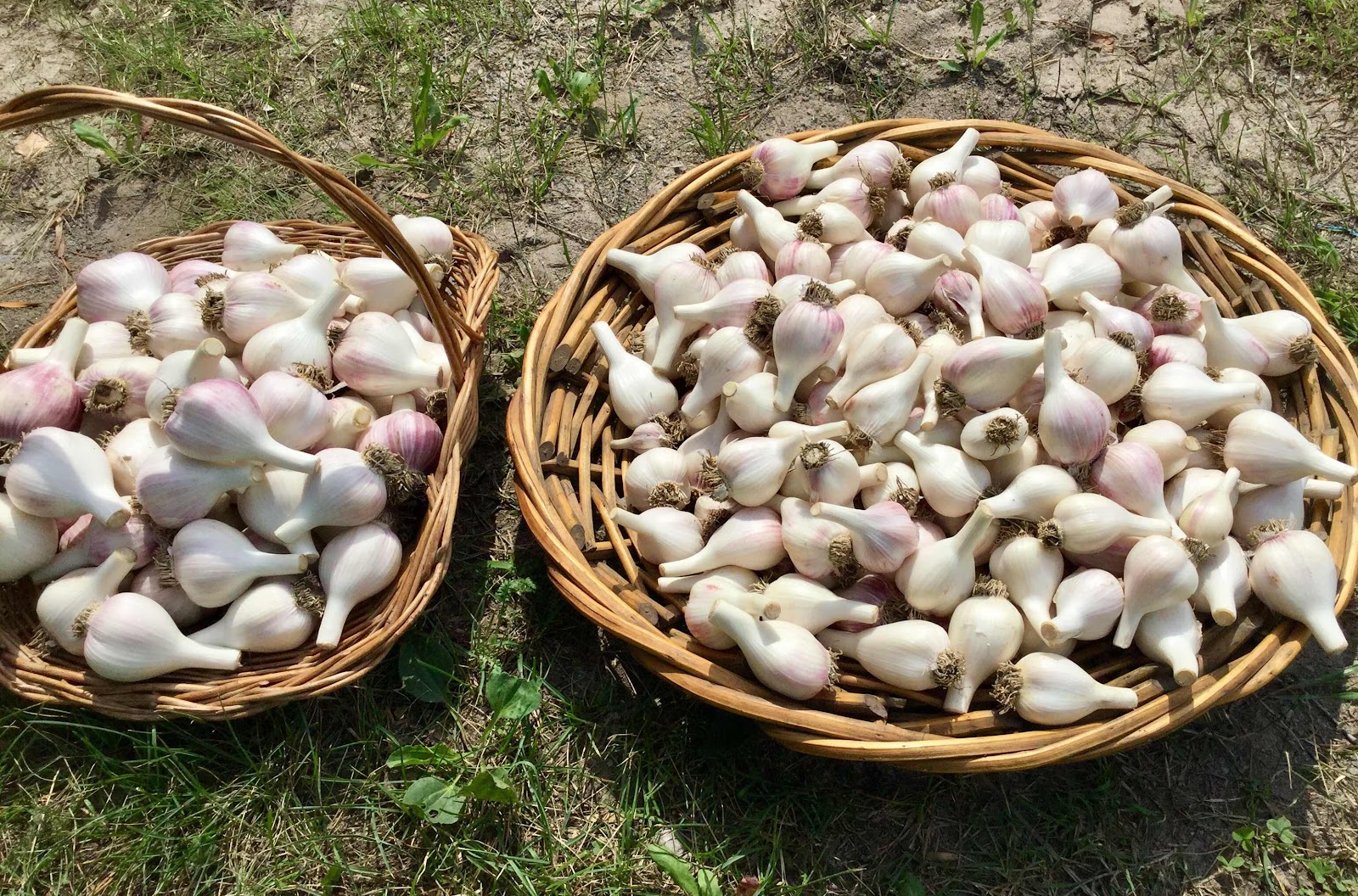
Certified organic garlic

Turning to Organics
By the time we purchased our farm in the hills twenty years later, I had decided to go all-in by developing a two-acre market garden with greenhouses and by growing and certifying according to organic principles. Pure nutrition came from a simple recipe - sunshine, plus fresh air and wind plus moisture from dew, rain and snow, plus organic glacial-till soil full of minerals. We feasted on fresh arugula, spinach, lettuce mix, mustards, and certified organic culinary herbs such as garlic, mints, basil, parsley, sage, rosemary, and thyme....
We ensured a regular supply of local grass-fed grass-finished beef and free-range chicken and eggs from farmer friends. No more of that industrial glyphosate-treated corn, grains, and feedlot grain-fed beef for us! I made herbal healing teas for various uses - digestive, relaxing, uplifting, for immunity support, against infection and winter chills. I even wrote a book around this time in our lives and this organic farming experience. It bacame a memoir entitled 'High Up In The Rolling Hills', published in 2013.

Fresh-picked Tulsi (holy basil), sunflowers, cilantro flowers

Our Medicine Cabinet
Our shelves remain free of any pharmaceutical medications. We remain stubbornly drug-free. Instead, you will find an eclectic array of flower essences, high quality organic essential oils, creams, and salves, dried medicinal herbs, herbal tinctures, homeopathics, vitamin and mineral supplements. The benefit of free drugs prescriptions for seniors on the public health system in Canada is lost on us. The occasional brief winter cold soon goes away with lemon, ginger, honey, hot peppers, and garlic in hot water. In childhood I had measles and chickenpox and, having enjoyed an active, sporting youth with many outdoor pursuits, find I have strong natural immunity. A resilient belief in bodily autonomy and personal informed choice for all stands me in good stead. I believe so anyway. As Eric Idle of Monty Python reminds us (come on, whistle along now): "Always look on the bright side of life..."

Conclusion
I encourage all to find simple natural solutions to health problems. Mother Nature has a truly wondrous and full medicine cabinet. All good things come from the earth, the soil beneath our feet, and the sky above. Sunshine, fresh air, pure plant and animal food, clean water, vitamins, minerals, and shelter provide the foundations to nurture and sustain us in body, mind, and spirit. Personal positivity can see us through many of life's challenges, wouldn't you agree?

Tuesday, 20 November 2018

Time to move on...

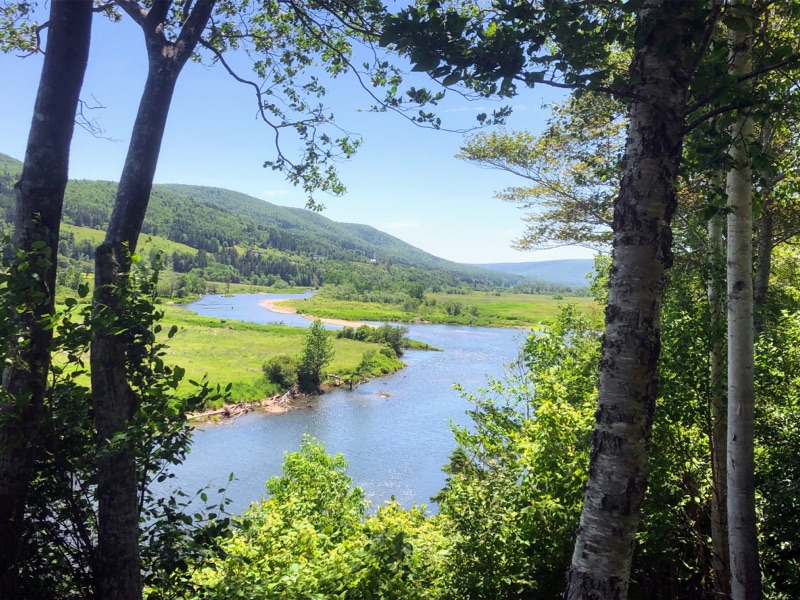
Our future home view in Cape Breton

Time to move on!

Gundi and I have now been living in these lovely Northumberland Hills for nineteen years. This has been a very happy and fulfilling period in our lives. Gundi has continued and elaborated her glass art sculptures and also returned to work (and play) with textiles in endless inspired forms. And I have put my heart into being an organic market farmer, growing specialty salad greens, herbs, and vegetables and taking them to twice-weekly markets, mostly in Toronto.

We are now up for a fresh challenge and the next chapter in our lives. We are embracing the prospect of living right on the ocean. A little cove in Cape Breton is calling us as our new home.

First, there is the little matter of selling our home, farm and land here. We are keen to pass on this special property (which has never seen chemicals) to conscientious buyers who will continue to steward it organically with a low-energy footprint. Lots of organic prospects responded to our posting on ecoproperty.ca and we had several viewings but we were unable to agree sales terms. And so, we are now on the open market, listed through Kim Hadwen of Century 21. Kim is a farmer turned real estate agent who specializes in farm properties in Hastings and Northumberland counties.

So, if you know of anyone who would love to own a secluded, very private farm property with an open concept artsy home and 55 acres of mixed hilltop with panoramic views, pastured fields, market garden, greenhouses, woodland, and wetland...

UPDATE: THE FARM IN NORTHUMBERLAND IS SOLD, THE HOME IN CAPE BRETON IS PURCHASED!
After our winter break on Lake Atitlan in Guatemala, ocean here we come!


Sunday, 21 January 2018

Ne Plus Ultra


Quintessence,

acme, zenith,

the ne plus ultra

of travels

far and wide;

green-girthed volcanoes,

cobalt-blue waters,

on this magical lake

at the top of the world.


An air clear and pure,

auras, vistas,

recharged by time,

each bright new day

a well-rounded wonder,

sweet natives embracing

bright-eyed travellers,

Buen día, indeed.

Monday, 15 January 2018

How we love to travel...

Motor boat and cayucos (fishing boats), Lake Atitlan, Guatemala, 2018


How we love to travel...


In my youth, I raced around Europe with countless other students, passport, traveller's cheques and InterRail monthly pass tucked into trousers. In thirty days, I would travel from England to Norway, Sweden, all the way down to Greece, back home via Yugoslavia, Italy, and France. Phew, that's a lot of trains, all for $75 or so; $2.50 a day, and just imagine the savings in overnight accommodation if schedules were planned well!


My first trip with the love of my life was a doozy. A long-haul flight with the impeccable Singapore Airlines took us from London to, yes, Singapore, a good, safe landing pad for me, experiencing Asia for the first time. From here, we flew to Bali, staying for a month before travelling overland across Java for another month, ending with two weeks in Malaysia, including a heavenly few days on the island paradise of Tioman.

Now, finally, thirty five years later, we are back to a trip that is two months plus. Instead of a busy itinerary, we now choose to fly to Guatemala, spend a few days in Antigua, then settle into a home away from home right on the jewel that is Lake Atitlan, happily rooted for a full eight weeks. After trips to Chile, Mexico, Costa Rica, Spain, Greece that were usually two to three weeks, we have graduated to longer and more satisfying stays. Last year, our first in Guatemala, was six weeks. Once we moved from hotels to rented houses and rented cars to public buses and collective taxis, everything changed for the better. We shop at local markets for fresh, in-season food, we cook at home, we flit from town to town on day trips, we relax fully, and we save a lot of money on restaurants and accommodation. And I get to plant seeds, growing arugula, lettuce, spinach, mustards, and kale for super salads fresh from the garden.


I chuckle to myself when I see each new harried young traveller, glued to his device, not even taking in where he is in the here and now, too obsessed with his inner world and getting to the next brief stopover. Most stay for a day or two here at Lake Atitlan, which is without question one of the most beautiful places in the world. One needs at least a week to do it justice. Then it is on to continue the Central American tour... Tikal, Belize, Nicaragua, Costa Rica, Panama.... Good for them. What a way to see exotic parts of the world most only dream of. Maybe I envy them their youthful energy as they race off climbing another volcano, diving to view pristine coral reefs, or riding Pacific surf. Instead, it's easy as she goes, all in good time, maybe mañana. Travel can be so life-affirming, given the opportunity it provides to take into our hearts vibrant cultures and exotic locales.

Tuesday, 7 February 2017

Just you and me


Just you and me
midst the birds and the bees,
the lake and its waves,
the peace that we crave,
the morning glory light,
a raptor aflight,
volcanoes frame the scene,
so radiant, serene.

Just you and me,
in this moment, we are free.

Tuesday, 24 May 2016

Forever Young


(Note to self on turning sixty, courtesy of Bob Dylan, with whom I share a birthday; Happy Birthday, Bob)

May your hands always be busy
May your feet always be swift
May you have a strong foundation
When the winds of changes shift
May your heart always be joyful
And may your song always be sung

May you stay forever young

Friday, 18 March 2016

Carpe diem


At this very instant (as I write), it is 10.07 am on February 29, a day that only comes around every four years. I find myself on a rooftop terrace in Patzcuaro, Mexico, part of a place we have been fortunate enough to call home for the last month. Tomorrow we head back to Mexico City, thence via Toronto to our permanent home in the Northumberland Hills of OntarioI am determined to hang on to this fleeting moment in time, to sip and savour it like a fine brandy, another treat in this adventure that is life. 

At this very instant, dogs are barking, cars and trucks are rumbling along the cobblestone street below, cocks are still crowing, a megaphone is trumpeting gas delivery, birds are twittering in the trees, voices in animated conversation from passers-by rise and fade, the dance studio is blaring out Arabic rhythms. The sky above my head is cloudless, the sun is bright and burns my northern skin. The town is humming with activity and street markets are in full tilt. The distant lake and girdle of gentle mountains are hazy and soft. I have slept soundly, breakfasted well. My time here has been liberally sprinkled with happy moments; it will linger long in the memory. A Patzcuaro portfolio derived from snapshots of many moments will stock my bank of souvenirs.

At this very instant, many millions of people are occupied doing many millions of things in millions of places around the world, all special and particular and meaningful to each person. Repetition and drudgery, hardship and boredom, pain and brutality may be involved, making the joyful, exuberant moments all the more special when they come around. I wish everybody instants in the sun like this one for me when the fresh, pure air cleanses and wipes away layers of emotional and physical grime and opens up new vistas. Tomorrow, new instants beckon as the reality of routine confronts us. It will be raining or snowing, or overcast. 

Seize the moment. Carpe diem.

Monday, 7 March 2016

Magic hour, Patzcuaro


(Written ten years ago during our first visit to Patzcuaro, one which Gundi called our best holiday ever. Ten years later, we are just returned from our second visit - a full month this time - probably an even more rewarding stay! This pueblo magico has lost none of its charm and has barely changed in the intervening decade. How many places around the world can make this claim?)

 A magical hour in a magical place. Early Sunday evening, in the Plaza Vasco de Quiroga, Patzcuaro, Michoacan, Mexico, the Americas.

The lights along the six portales of the palisaded rectangle are all of a diffused yellow, as if a thousand candles have just been lit. The six centuries-old leafy ash trees are fluttering in the light breeze, the birds are all atwitter in the high branches, and dark is newly descended. The central circular pool in the park, guarded by Don Vasco, is placid and mirrors the lighted scene above, while coy young lovers tangle, forming a ring around its rim. Whole families are out de paseo, dressed in their Sunday best, reveling in the fresh early Spring air. Toy ponies transport wide-eyed toddlers in a lap of the pathways; exuberant little girls with flowing black hair, red and pink dresses, long white socks, and shiny black shoes skip, scooter and bicycle by, and a tiny year and a half-old boy hoots with delight as he plays peek-a-boo around the massive girth of a limed-white tree trunk. His mother happily passes him over to a complete stranger so that she can share in the joy and wonder of being that innocent age. Cars trundle in slow-motion over the cobble-stoned streets, some emanating a deep boom-box bass beat. The atmosphere is gentle, sweet, beguiling as natives and visitors mingle, embracing the warmth of sharing this time together, at leisure and in peace.

Restaurants serve food, bars purvey drinks, artists show their landscape paintings, artisans display their crafts, vendors peddle clothing and toys, ice creams and pastries. Most is locally produced. In the adjacent mercado, they are just shutting up shop for the day. The array of colorful fresh produce is staggering – papayas, mangoes, guayabas, pineapples, melons, bananas, coconuts, strawberries, blackberries, apples, oranges, limes, lemons, tomatoes, avocadoes, potatoes, onions, herbs of all kinds, cauliflowers, cabbages, beans, corn, beets, carrots, meats, fish, you name it…. At the food stands, mamas and papas and their niños huddle around hot pots of steaming stews; tortillas are warmed as a base for sauces and fillings. Smells and sounds pepper the air, and colour suffuses the scene.

We enter a patio courtyard sanctuary decked with bright table-cloths and take a seat to survey the panoramic mural of the Mansion de los Sueños, the mansion of dreams. The mural is a delightful tableau of local campesinos and townfolk, out wandering and picnicking midst the mountain- and lake-scape that snuggles up to the town. Glowing belles are serenaded by elegant troubadours as fresh fruit laps at their feet. Isla Janitzio glistens as the jewel in the crown of the lake. We drink tequila with limon and savour fresh trout, soaking up the music and the starlit night air. 

Friday, 27 November 2015

Appealing to our Better Natures

Pieter Bruegel the elder, The Triumph of Death, painted c. 1562  


It is hard to change learned behaviours, but change is imperative. We have no choice if we are to halt and reverse the frenzied drive through the bleak landscape of societal and ecological decline. The climate is changing faster than we recognize. There are some that, remarkably, still - heads in the sand - fail to recognize this at all,  while calamities befall mostly those who can least bear them. Where will the next one hit?

At the top, governments are creaking. Their stock response to new challenges is often to pile on more misery through austerity and cuts to services. Refugees are corralled, ridiculed and marginalized. Hundreds of millions of people across the globe have been cast aside by globalization as human refuse. They are worth nothing to the corporate state. They are denied jobs, benefits, dignity and self-worth,” writes Chris Hedges at www.truthdig.org.

 The natural world is assaulted and battered. Wars proliferate; nations and countless (undocumented) innocents that do not count are condemned to an endless  cycle of suffering. Tit-for-tat, an-eye-for-an-eye, it is said, leads to a world that is blind. The elite are laughing all the way to the bank, of course. They double down on their attrition, knee-jerk vengeful reactions, arming shady militias and switching sides with their divide-and-conquer tactics. They shake it up, drive a wedge, and deliver with shock-and-awe pyrotechnics for the home audience. At the same time, pressing issues are ignored, vital choices are sidestepped, as governments in cahoots with corporations dither and obfuscate, kicking the collective can down the road, leaving their successors and future generations to try to clean up their mess.


Stand back, take a deep breath, and reflect. Where does all this lead? Where does it end  up? Back at the beginning, where we were, no progress made? What goes around, comes around. As Jean-Baptiste Alphonse Karr  noted in 1849: “Plus ça change, plus c’est la même chose.” Time to press re-set and start over with a fresh approach.

***

Hieronymus Bosch, detail from The Garden of Earthly Delights, painted 1503 - 1515

At the grassroots, a willful transformation is taking place, taking root and flourishing in many communities around the world. Passionate, fiery voices tell it as it is. They champion vital causes. They are intrepid souls like Vandana Shiva, Naomi Klein, Jane Goodall, Helena Norberg-Hodge, Jon Pilger, Chris Hedges, Julien Assange, Edward Snowden, Paul Craig Roberts, Eric Margolis, David Suzuki, George Monbiot, Nafeez Ahmed, Thierry Meyssan, Yanis Varoufakis, Derrick Jensen, Bill McKibben, Joel Salatin and many, many more….

Organizations such as Greenpeace, 350.org, Resilience, Sustainable Pulse, Survival International, Friends of the Earth, The Ecologist, Bioneers, Transition Towns Network, Pachamama Alliance, NextGen Climate, The Cornucopia Project, Non-GMO Project, Avaaz, WikiLeaks and many many more are raising the consciousness and effecting genuine change. The paradigm shift is underway. These worthy, truly transformative efforts are already stemming the slide in so many directions – a warming planet, extreme weather events, acidifying oceans, chemical pollution, heightened atmospheric radiation, depleted and poisoned soils, desertification, deforestation, threats to democracy, national and personal freedoms and much more besides….

Caring and sharing are occurring allowing a certain level of healing to occur. A parallel economy, replacing competition with co-operation is sprouting, utilizing principles of localism. Using only what we need, when and where we need it, individuals, families and communities are learning how to be frugal, minimize waste and work together creatively in a spirit of collaboration.

Social media have taught us valuable lessons in how to share, with friends, with community, with the world. Gone (sadly) are the days of letter-writing as a principle way of staying in touch across distances. We still have the ubiquitous phone, but lives have been transformed by the convenience and speed of text, instant messaging, email, digital video and image. We post to our Facebook wall, tweet, blog our thoughts and post our photos on Instagram. In sharing so instantly and often with our circle of friends and the world at large, we are having to learn how to prioritize our time instead of wasting it, and these lessons are hard. Time that used to be spent talking in person is replaced by hours of solitary surfing, browsing, ogling, googling, messaging, commenting, liking and posting, in thrall to our personal devices. Slaves to technology, it is easy for us to forget to look up, smell the coffee (and roses), spend time in Nature, and truly take in our surroundings, especially when swept away in the moment.  But at least in our digital pursuits, we are generally sharing, be it information or entertainment.

A lot of these easy means of communication come to us for free. Facebook, YouTube, Twitter, Instagram, Pinterest, Blogger, WordPress and many apps are there for the taking. It is no wonder that we are streaming movies and news, using wi-fi, posting freely and abandoning mainstream television and newspapers. The talking heads of TV and the puppet scribes of the press are delivering mainly bland commentary sanctioned and sanitized by the corporate barons and their elite; alternative viewpoints online can be so much more salient and edifying when one learns where to find them midst the hysteria.

At the same time, many of us are seeking ways to share more locally, within our communities. While it is nice to be able to drink fine wines from France and Chile, eat artisan cheeses from Italy, sip on fair trade coffee from Costa Rica and Columbia, and use organic olive oil from Spain and Greece, we need to grow more food locally and market, consume it within our community.

Many of us have too much stuff stowed away; stuff that lurks in boxes and cupboards and basements, rarely seeing the light of day; stuff that other people could use. We have over-consumed. We can shift focus from buying-and-selling-and-renting-and-wasting to sharing-and-trading-and-using-and-returning. This would foster community participation and networking. As an organic farmer selling at farmers markets, I know well that it is good to trade with fellow-farmers and-producers; to share experience and knowledge with customers. A personal goal is to help develop a localized free exchange & trading of goods and services in the community which I call home, in which money does not need to change hands. A pilot program here in Northumberland is mooted.

The corporations may be tightening their control and governments may be leading us into wars and want with no end in sight, but smallholders and radical thinkers around the world are making a difference in effecting substantial change at the local level. In appealing to our better natures, they are helping to build resilient communities based on eternal virtues of love and empathy, through caring and sharing. Back in 1759 Voltaire advised in Candide “Il faut cultiver notre jardin.”

In 1969, Joni Mitchell sang
“We are stardust
We are golden
Billion year old carbon
Caught in the devil’s bargain
And we’ve got to get ourselves
Back to the garden.”

And in  1973 E.F. Schumacher authored “Small is Beautiful” , championing village-based economics and smaller-scale, appropriate technologies. It is time to re-adopt  forward ways of thinking. Press Re-set. After all, as Vandana Shiva says: “We are all seeds.”


Wednesday, 18 November 2015

Remembering my dear old Dad

My sister Jenny writes: "It's hard to believe that today is the 10th anniversary of Dad's death." On this day, I am filled with loving memories. His spirit lives on.

In High Up in the Rolling Hills, I wrote:

Dad stayed in constant touch and kept right up to date on my latest. A year after a walk on Kinver Ridge to view his proposed resting place, it was time to visit Mum and Dad. Acutely aware of his vulnerability after several minor heart attacks, Dad had for a while been tying up loose ends, putting his affairs in order and making arrangements. I spent a week with them at their home in Bournville, in south Birmingham. This week, to be his last, was filled with bright, sunny days and cold, frosty nights. Dad was full of his usual mix of thoughtful musings and happy banter. He paid homage to the fallen ones throughout the week leading up to Remembrance Day. He made his usual care-giving calls to ailing friends and neighbours. He reviewed and updated the Finch and Mullins family histories, talking glowingly about his mother and father. He was thrilled to make the first sale of his poetry collection. He listened to the cricket on the radio. He revelled in Chopin nocturnes and Mozart piano concertos. He even burst into song more than once as he showed me his revised funeral service program.

The family enjoyed meals together. We picked and ate the last raspberries from the garden. We went for sunny walks in the park. My sisters and I reminisced about our childhoods, happy times for him and for us. Above all he was overjoyed to spend time with his closest family - his beloved Mary, his daughter Jill visiting from Berlin and me from Canada, daughter Jenny and her husband Bob, granddaughters Anna and Sarah, all of whom had been constantly close by for Jack and Mary in recent years. All of us were with him on what turned out to be his last evening. Just grandchildren Mieke and Janko and my wife, Gundi, were sadly not with us at this time.

Then, on a sunny afternoon stroll in the park with Jill, a massive heart attack struck him down and Dad suddenly took leave of us, a contented soul with an enlarged heart filled with love. His spirit will live on in all those that he touched with his humility and boundless love for people everywhere. His journey continued as he moved on to Kinver Edge, where the earth meets the heavens for him. From there, it was on to the great beyond. He had told me that death held no fear for him. He believed that it would reunite him with loved ones that had gone before.
A plaque on a bench up on Kinver Edge in memory of another departed one reads:
May the winds of love blow softly
On this quiet and peaceful place
Where our loved one
Will never be forgotten.

Monday, 17 August 2015

Seeking Balance

At Fairmount Park Farmers Market

In bestriding this precious gift called life, I’m seeking balance. This being my sixtieth year on this Earth, I find myself looking back in the rear view mirror toward the distant innocence of childhood, just as I scan with firm gaze the curving road ahead. The secret is to simultaneously revel in the present. Peak summertime is upon us and with it comes a sharp awareness of its transience. Without dwelling on its ephemeral nature, I steer from the physical to the cerebral, farming to marketing, hard work to gentle play, outdoor to indoors, home to travel, relaxation to stimulation….

Many food-growing farmers are stretched at this busy time of year, arriving at market weary and dazed from their strenuous labours, energy-sapping heat, and daunting harvesting and sales schedules. My twice a week farmers market appearances in the city lend interaction with appreciative customers and are a pleasant break from the back bending and leg wilting of farm exertions. 

Soon enough it will be Fall with cooler days of earthy fragrances and crisp nights to ripen off the fruits of our labour. And then balance is provided by the more leisurely pace of winter with its intense cold outside, warm wood fires inside. The prospect of a respite in the warm embrace of small-town Mexico, shared, we hope,  partly with family and friends is enticing indeed.

Thursday, 12 March 2015

Impressions of Cuba. Part 2, Havana


We’re on our way to la capital, the grand old lady, la Habana. After an early rise, breakfast, and tallying up with Magaley at our casa in Trinidad, we departed on foot to get to the bus station in good time. After the chaotic scene at Varadero, we had decided to pre-book the trip, though we would have to line up to pay with everyone else. Immediately on arrival at the terminal, we were approached by a couple eager to convince us to take a taxi for the same price as the bus that would take us direct to our casa in Havana and shave the travel time in half, from six hours to three. We decided to go for this, thereby avoiding all the schlepping of luggage, scrambling for seats, and dawdling through many towns for several stops en route. Our bags were bundled into the trunk of a regular car; we were ushered into the back seats, and we were assured that two more passengers would see us on our way.  Something was amiss and the young guys were shifty. A drive around the corner for a prospective customer was in vain. Two young guys then drove us across town to two Americans – one still in bed – who had booked a taxi for big money to take them, their baggage and two bicycles to Havana, an hour and a half hence. They were not best pleased to see us occupying half the seats, and I demanded to be returned to the bus station, from which our bus had already departed! It was our good fortune to discover a state taxi van just departing to pick up two customers, with ample room for us to join them. Thankfully we had not paid the hustlers, and off we drove to Havana. Our driver was friendly but very frustrated to have worked 26 years for Fidel and Raul for very little pay, only for these young entrepreneurs to threaten his livelihood. He had had enough and was ready to quit, barely breaking even after his fuel and licensing costs.

The journey was fast, breezy and enjoyable, spent ruminating on the beauty of the Cuban countryside, the immense challenges the country faces, and the endless potential for it to grow food, use renewable energy, and harness new investment from outside at the appropriate scale. After two and a half hours we were hurtling into Havana. Pleasant approach highways were strewn with locals awaiting transportation into the city by bus, taxi, or truck.  No sooner had we glimpsed the ocean than we dipped in the tunnel that delivers traffic under the harbour and into the city. The Malecon, the Paseo del Prado, Parque Central, El Capitolio, Teatro Nacional and the Hotel Inglaterra, and then we entered a warren of narrow streets line by three- and four-storey buildings in various stages of disrepair. People, people everywhere, going about their regular business, trading, shopping, selling, snacking, guzzling, chatting, hugging… Our driver delivered us to our casa particular and I gave him a good tip (not for Raul, I stressed). He laughed and thanked me.

We had chosen this casa because of the rave reviews for Cary’s home cooking and the affability of her husband Lazaro. These two lived up to their reputation and we became enamoured of the whole family, including their daughter and sweet grand-daughter, their maid, and Lazaro’s brothers. Outgoing and supremely hospitable, they were always ready to laugh, joke, chat, and make suggestions of places to visit. We shared our days here, first with a Swiss family, not Robinson, but Freiburghaus, then with two lively German couples from the Frankfurt area. Breakfast and dinner were exuberant occasions thanks to the home cooking and infectious enthusiasm of Cary and Lazaro. The house is approached via an unassuming door to the street, Calle San Rafael. Our simple, clean, colourful room was up the first flight of stairs. A second flight leads up to the kitchen, office, dining room and rooftop terrace where the social interaction, cooking and dining take place. A memorable evening was spent dining, sipping rums, smoking Cohiba cigars, all the while watching Cuba beat Venezuela at baseball in the Caribbean championship on route to being crowned champions. Cuba! Cuba!

A few short blocks thronging with locals ferreting around and socializing, and we were at the Hotel Inglaterra and the Parque Centrale, with the expansive streets bustling with traffic of every stripe – 1950s vintage Chevrolets and Chryslers, electric three-wheeled egg-shaped taxis, bicycle taxis, oversized and double-decker tourist buses and new Hyundais and Hondas. The park was animated by young Havana men arguing loudly (about baseball, not politics!). To the east of the park, Calle Obispo is a narrow streak of a street jam-packed with tourists and locals. Deals are going down and gullible turistas led on wild goose-chases down side-streets to “best restaurant, cheap food, my family, best mojito…”

Old Havana’s narrow streets protect from the stifling heat of summer. Now, in winter, the atmosphere is vibrant and colourful. We are shocked by the volume of tourists, especially at Plaza Vieja and Plaza de la Catedral onto which they spill from the neighbouring thoroughfares and from their mega-buses and mega-cruise ships moored at the adjacent harbour. The architecture is a mesmerizing mix of styles. Plaza Vieja buildings have been fully cleaned and renovated under grants from UNESCO and the EU. Just off the square, the bare bones of a baroque building spill masonry and sprout greenery; it is topped by a giant crane.  Some streets are upside down as they replace ancient corroded heavy metal with new plastic sewer pipes. The odd bulldozer and track cart the debris away, but heavy machinery is at a premium as in other layers of the economy. Some buildings are mere shells, hollowed out and exposed to the elements; others are at various stages of disrepair and salvation. And then, there are ornate gems of great heritage that have been meticulously made over.  

A cultural highlight of our meanderings through old Havana was a visit to the expansive Museo Nacional de Bellas Artes. Three floors house a treasure trove of modern Cuban art. The works range from serene to edgy, fiercely political to intensely personal. They share an intensity and sensuality that are essentially Cuban. Particularly striking are works by Wilfredo Lam, Carlos Enriquez, Amelia Peláez, and Raul Martinez. Photos were prohibited, so the emotion the paintings convey needs to be inhaled. It is rare for a collective body of work by many artists in a range of styles to pack such a punch.

We wander into open buildings revealing cool inner courtyards and rooms housing displays of paintings, ceramics, sculpture, period furniture. Most are free of charge, but often willing guides are hungry for a cash tip. Musicians in bars and restaurants, guides, cigar-smoking women in traditional costume, cigar-sellers, reciting poets tout their wares and services, all eager to make a CUC, the cash that can feed them and their families and enrich them way more than a state job can at the present monthly pay of 25 – 30 CUCs. 

Music suffuses the air – at street corners, in bars and restaurants, in parks, solo and ensemble. Styles run the gamut from campesino to salsa to jazz to classical. The sounds create a warm ambience and the playing is superb. Accompanying a good dinner, we were aware that a band setting up could be the signal for conversation to be drowned out and the tip basket to make an imminent appearance.

Lunch was enjoyed at Café Neruda, right on the Malecón, looking out over the choppy Caribbean Sea; also at Café Bohemia, tucked away in a courtyard off Plaza Vieja. At night, we loved eating outside at Santo Angel in the balmy air of Plaza Vieja, and the pasta at Dominico’s was superb. At Café Europa, half the menu had been scratched and the offerings that remained were over-cooked and dried out. On our last night in Havana, we chose well. The fresh fish and camarones al ajillo at the Club Nautico Internacional were succulent. The exotic atmosphere perched above Havana harbour, with regular Cuban guests for company, looking over the water to the Casa de Che, and back to the moored German cruise ship ablaze in yellow light was, to us, quite magical. Our nightcap was 7 años Havana Club rum on a balcony overlooking Plaza Vieja.

For us rural Canadians parachuted from outdoor surroundings at home that are drained of colour and in deep freeze at this time of year, Havana is an urban scene that is positively intoxicating in its rich stimulations and seductive contrasts. Constantly, senses are assaulted by an enchanting facial gesture or exuberant architectural flourish. After several days of soaking up the atmosphere, eating and drinking with abandon and walking our legs off, we were ready for another change of pace. 
  

Thursday, 5 March 2015

Impressions of Cuba. Part 1, Trinidad.


When we go out from our selves and wander further afield we discover out there a world of wonder as we open our eyes to the other, the exotic, the wild, and close our ears to the noise around us, streamed and screamed by those that lord over us, passing legislation we didn’t ordain…
How sweet it is to escape to where joy in living prevails and a happy greeting on the street is oh so genuine and just…understood; simple life, honest people, salt of the earth, just trying to be, resiliently.
Given the gift of life, we all need a seat at the table where love is served.

Trip planning started last summer with a perusal of airfares to Mexico, Lanzarote, Mallorca, Dominican Republic, Ecuador, Chile… all $1,200 plus and most involving a stopover in the United States. No thanks. Then, this thought surfaced from the recesses of memory. What about Cuba? We had always wanted to go, with friends having recommended it highly. However, some nagging doubt always got in the way and other destinations pushed themselves to the front of the line. Mexico, the Greek islands, Costa Rica, Andalusia won out. This time, the $420 airfare and the 3-hour direct flight were a gift we couldn’t pass up. When the United States government announced a proposed easing of its embargo, we knew we had made the smart choice. Going now, we would be able to observe a country that had to date endured 56 years of punitive restrictions via a blockade led by the United States, but followed by most nations of the western world.

Power in the island nation had been doggedly held by Fidel Castro and then his elder brother Raul since the socialist revolution of 1959.  To travel there now would be to capture a rare moment in history, where the pace of change had slowed to a crawl, where life went on much as it had some sixty years prior, but where change was imminent. Through the embargo years, some Cubans have found a way to access the outside world of communications and consumer goods only through great ingenuity.

At the end of January, we departed Toronto just as the cold and snow of winter were intensifying. A window of bright green, sun-dappled vegetation opened between the clouds as the plane banked to land in Varadero. Our first casa particular awaited us in a backwater a taxi ride away from the coastal strip of endless sand beaches.  The elegant house and inner courtyard were an oasis of tranquility and charm and our host family very welcoming. Home-cooked dinner consisted of a wonderful lobster cocktail followed by succulent fresh shrimp.

The next morning, our first waking up to bright Cuban sunshine, there was an early start with our hosts kindly driving us to the bus station. Eager to get off on the right foot, we had pre-booked our 6-hour Viazul bus journey to Trinidad on the south coast. Viazul has large buses covering the main tourist destinations in Cuba, namely Havana, Varadero, Cienfuegos, Camaguey, Holguin, Santiago de Cuba, Trinidad, Viñales. They have a reputation for being reliable and punctual, although their routes take them meandering from town to town with frequent stops, which makes for lengthy journey times. Despite having pre-booked tickets, the check-in process was a nightmare and in my desperation to get on the imminently-departing bus, I jumped in front of a livid Frenchman to show my ticket. The first towns we drove through were shocking in their stark state of disrepair. Deserted streets, unpainted crumbling facades, no vegetation. In contrast, the countryside was a patchwork of fields of rice, cane sugar, bananas, pasture, and fallow, with horse-and-cart, bicycle, collective truck the preferred modes of transportation. We made stops in Santa Clara and Cienfuegos, both large bustling towns, and the latter is said to be very beautiful with its French grid layout and coastal location. The bus then climbed to the foothills of the Sierra del Escambray mountain range before descending again to the verdant coast and sparkling sea en route to Trinidad.

Our accommodation in Trinidad was another pre-booked casa particular. It is located on a street down the hill from the bus station, historical centre, and cultural hub. Trinidad is a small charming town best explored on foot. Over the coming days we would traverse the streets time and again, often pausing to look up, wonder, and snap shots. The town is so photogenic with its red-tiled roofs, vibrantly-coloured frontages, cobblestone paving, vintage automobiles, brightly-dressed locals, all backlit by deep blue sky. Trinidad is teeming with tourists and tourist buses, and each species comes generally over-sized and excessive in number. It is hard to find a seat when a bus unloads its contents and swarms an eatery or drinkery. The musicians love it, of course, and set themselves up rapidly at restaurant entrances, starting to play their often wonderful campesino and salsa songs, as one of their entourage goes around with basket of CDs and banknotes, prompting a frenzied fumbling in pockets from wide-eyed turistas for small bills or preferably change. The mood is festive and fun with the free-flowing mojitos, piña coladas, cuba libres, rons añejo putting all in good spirits.  Five days and nights in Trinidad was a good amount of time to soak up the delights of this sweet town. Nights were lively with live music indoors and out; the restaurants we chose served a range of foods from the bland to the excellent. We particularly enjoyed dining on seafood al fresco at La Ceiba. Ceibas are often huge specimen trees in Cuba, with an enormous spread. This one is magnificent and was flowering but leafless at this time.

The beach at Playa Ancon is a bus ride away, though our frustration at the unpredictable schedule led us to take a vintage station-wagon taxi one day. The beach is clean, the acqua waters seductive. Two large hotels here cater to the all-inclusive crowd, and the appeal of a fast, extremely reasonable getaway to Cuban sun, sea and sand is clear. At the opposite end of the spectrum, the weekly farmers market in a residential area of tatty low-rises on the edge of town is essentially for locals, but a rare opportunity for us to divest ourselves of some of the national currency. However, everything here is so dirt cheap that it is impossible to spend much, with enormous cabbages for example priced at 1 peso, or 5 cents.  CUCs are Cuba’s exchange currency, with 1 CUC being pegged at $1 US. All tourists trade in this currency except when purchasing local products from locals. Most small businesses and shop owners accept only CUCs. With the Canadian dollar having recently declined in value against the greenback, our exchange rate throughout our trip was not favourable and made Cuba more expensive than anticipated.

Trinidad’s treasures are many and are mostly clustered in the old historical centre of town around the Plaza  Major, including the Museo Romántico and the Museo de Arquitectura Colonial. We most enjoyed listening to the lilting campesino music whilst people-watching at a welcoming sunny outdoor patio, mojito in hand.

Friday, 28 November 2014

A Trip to the Old Country

I returned this week from a trip to the old country. Missing several days of wild snowy, blustery weather here at home, I enjoyed mild and mostly dry conditions in England and north Wales.

Niece Anna ’s wedding with Dan was a traditional church affair, and it was lovely to see Anna wearing my Mum’s flowing white dress from her August, 1946 wedding in Horspath, near Oxford, some sixty eight years ago. 

Mary Mullins, August 12, 1946
Anna Blackaby, November 15, 2014

After the ceremony, Anna, Dan and the entire wedding party walked over the English Bridge and strode proudly up the hill into Shrewsbury town centre and to the reception at Mission Hall. It is always lovely to reconnect with family in person and it happens all too rarely these days. For me, this means two sisters, a brother-in-law, three nieces, one nephew, one great niece, and two great nephews. My sister Jenny and I even worked in a visit to Mum and Dad at their resting place up on Kinver Edge. A mild morning was illuminated by a bright early winter sun as we approached the ridge where their ashes are spread. We communed with their spirits by way of tulsi tea from holy basil I had grown and dried this summer, along with local ham and cheese baps.

 
Jenny and Peter up on Kinver Edge

 This family occasion was followed by several days in Snowdonia. The train delivered me first to Llandudno, where I got my fix of archetypal Victorian seaside, wandering along the salty promenade, supping on fish and chips, mushy peas with sliced white bread and a pot of tea. Pints up the pub whilst watching England beat Scotland at football, full Welsh breakfast , a bracing walk up on the Great Orme headland… Then it was off on the train again up the scenic ConwyValley to Blaenau Ffestiniog in the wilds of upland Snowdonia. The landscape up here is stark, open, and overwhelmingly grey. An historic slate mining town, mounds of slate are everywhere, piled dense and high. Small-gauge railways that were built to transport the slate down to the coast are now quaint tourist attractions that still run seasonally. My walk took me up above the town to a placid lake and  the tufted grasses and browned ferns of mountain sides dotted with sheep, and ever more slate excavations. The sky was slate grey reflecting the land use. And water was everywhere, tumbling down the valley sides in gurgling cascades and spilling over the saturated soft peaty turf underfoot. After weeks of rain, it was still finding its way slowly into the soil and down the hills. The dampness everywhere created a melancholic mood but nature here is pure, clear, and ever in flux. A Turneresque sky would momentarily appear as  sunrays broke through the clouds and bathed a distant mountainside in diffused light.

Back down in the lowland, the river Conwy sweeps broad and majestic through the green fields. The Bodnant Estate hosted four of us college buddies for a long weekend as we made a very well appointed Welsh farmhouse perched high up overlooking the valley our home for three days and nights. A Blaenau butcher and Bodnant’s  Welsh Farm Shop provisioned us with excellent local, artisanal foods like black Welsh ribeyes, a shoulder of lamb, Severn -Wye smoked salmon, local vegetables. Our wines were more international, of course, with French Chablis, Chilean Carmenère, Australian Shiraz, Argentinian Malbec to the fore. Needless to say, we did not go thirsty or hungry. Conversation was rapt in reminiscence of good times spent during our years studying and carousing in Oxford. As we chat, we bounce around the world, and the world bounces off us. Next year, we look ahead with some trepidation to the landmark 40th anniversary of our meeting at college. Yikes, where does the time go‽ How easy it is to be among friends that one has known so long. How readily the laughter flows. How nice not to be judged or criticized by others, but to be readily accepted for who you are, no questions asked.


In Britain today, people ply their trades and go about their lives as they traditionally have. Yes, the world is changing fast, and everywhere people are distracted, slaves to their devices and technologies that have them all aflutter. They cannot readily unwind, disconnect and smell the coffee, take in a deep draught of pure fresh air, take a good look around. Stimulation is around every corner and I was glad to be in the moment, alive to sense and sound as we walked purposefully across the landscape. Soaking up the scenery and the company, I felt the special love that comes with truly appreciating friends and family.

Andy, Peter, Jeremy, Neil at a Welsh farmhouse